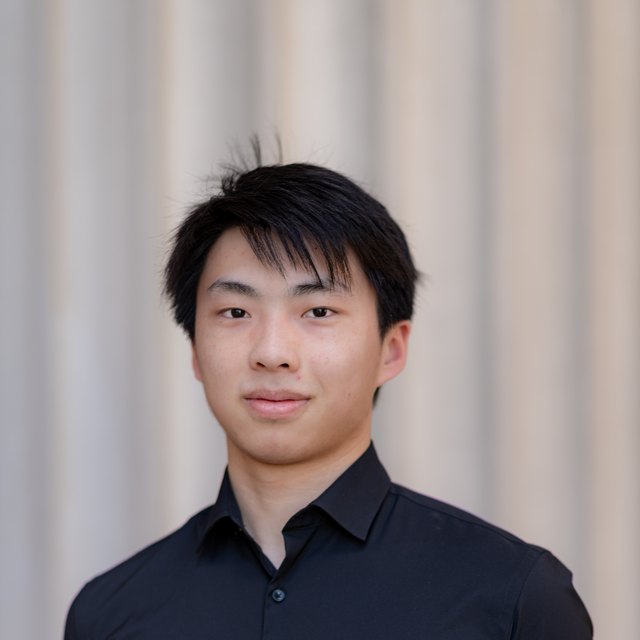
Portrait of Niles Liu

Niles Liu

Incoming Harvard M.S. Data Science · thesis track
MIT 2026 · Mathematics & Computer Science

Optimal transport moves probability mass from one distribution to another along the cheapest coupling. It sits at the mathematical core of much of my research. How do you sample the modes a dataset under-represents, and how do you know when a model has them right?

About

I was drawn to machine learning by a simple premise: from data, we can learn the distributions behind it and reason about what comes next. The questions that hold me are about coverage and calibration: covering the modes a dataset barely shows, and knowing how far to trust a prediction. My work follows that thread, across generative modeling and optimal transport for high-dimensional, imbalanced data, uncertainty quantification for high-stakes settings, and the evaluation methods that tell me whether any of it holds up. I care more about getting the method right than about architecture novelty. The problems that pull me in are the ones where being honest about what we know is the hard part.

I have done as much of this outside the lab as in it, building production systems and consulting on real problems, where a method only counts once it survives messy data and a deadline.

generative modeling · optimal transport · geometric deep learning · uncertainty quantification · conformal prediction · evaluation methodology · ML for science

Conformal prediction turns a point estimate into an interval with a coverage guarantee, and lets the band widen exactly where the model has earned less confidence. Calibration like this is what makes a prediction safe to act on.

Research

Optimal transport ETH Zürich

Generative modeling on manifolds

Learning & Adaptive Systems Group · Dr. Ya-Ping Hsieh

The challenge was imbalance. Training distributions are long-tailed across protein families, so diffusion samplers drift toward the modes they have seen most. I proposed a trajectory-consistency objective, called adjoint matching, that aligns forward and reverse dynamics to encourage exploration, then derived a manifold-aware variant for SE(3)-constrained spaces. In controlled tests it recovered minority modes that standard samplers collapse without trading away accuracy.

Uncertainty quantification MIT IMES

Calibrated UQ for clinical machine learning

Institute for Medical Engineering & Science · Dr. Li-Wei H. Lehman

In the ICU, a false arrhythmia alarm is a calibration problem before it is an accuracy one. The cost of crying wolf and the cost of a missed event are nothing alike. I used deep-ensemble fully-convolutional networks and conformal-prediction measures to put a calibrated number on each prediction and bring down false negatives.

Evaluation methodology Starwood Property Trust

Reproducing expert comparable selection

Self-directed

I framed real-estate comparable selection as learning-to-rank over roughly six million properties resolved across several databases, trained on the comp sets expert analysts had actually chosen. The result I am proudest of is a negative one. A plain per-row classifier beat the listwise ranking objectives on realistic full-pool retrieval, even though those rankers won on closed-set cross-validation. That gap turned out to be a methodological trap worth fixing: I rebuilt evaluation around full-pool tests, pre-registered ship-or-reject gates, and honest reporting of nulls, then showed the real ceiling lives in candidate generation rather than in the ranker.

Retrieval-augmented generation grounds a model in evidence rather than memory: it pulls the passages closest to a question, then writes its answer from what it found. Letting a model look things up instead of trusting it to remember is what makes the answer trustworthy.

Selected industry work

Independent consulting Stealth

Pivotal-trial biostatistics

Brought in as an independent consultant, I owned the analytics for a medical-device company's pivotal Phase III trial end to end, as the only data scientist on the engagement. I built the pipeline from locked clinical-data exports to analysis-ready datasets, then ran the statistics on top of it. Survival analysis, recurrent-event modeling, and a hierarchical composite-endpoint adjudication for win-ratio comparison. I wrote a Monte Carlo trial simulator to stress-test endpoint definitions and statistical power, and built the operational analytics that tracked activation across dozens of international trial sites. One consultant, the full statistical stack of a pivotal trial.

Software engineering Burmester & Vogel

Maritime document intelligence

A top contributor to an Azure pipeline that turns messy maritime documents into structured, queryable records, I built several of its components. Most notably, an in-process TF-IDF and logistic-regression classifier with confidence-gated LLM escalation beat the LLM outright on the highest-stakes class, at a fraction of the cost. The last few percent of accuracy never came from more data. They came from methods that could absorb the inconsistencies of real documents.

Data science Starwood Property Trust

A real-estate ML portfolio, built solo

At Starwood, every project I take on is mine end to end, built solo. Over the past year that has meant five production-grade systems: the comparable-selection research above; a data-only valuation model with rolling-origin validation and conformal intervals; a similarity engine that reconciles two databases that agree on almost nothing; a document-extraction platform now in production; and a market-scoring agent on a point-in-time panel with a deterministic, auditable rubric. What stands out is the pace: in a single recent month I shipped two of them, pushed a third to production, and built a fourth from nothing to a working v1.
Time-to-event analysis. A survival curve steps down as events accrue, while the shaded band tracks how much the remaining data can still support and the ticks mark patients censored before the end. Two arms pulling apart is the question a pivotal trial exists to answer.

Open source

A single thread runs through the work above. On data that is noisy, autocorrelated, and regime-shifting, the hard part is rarely the model but knowing whether a result is real. These projects are that discipline made concrete, all MIT-licensed and runnable on synthetic data. They are built on walk-forward evaluation, leakage controls, ship-or-reject gates fixed before the run, bootstrap that respects correlated samples, calibrated uncertainty, and a willingness to publish the null.

Conformal prediction · UQ GitHub ↗

conformal-selective-uq-public

A selective conformalized-quantile regression method that holds group-conditional coverage under distribution shift and abstains where the signal is genuinely unrecoverable. The abstention is validated, not asserted: the target carries a known, injected noise floor, so I can show it drops the points that were never recoverable. It makes no alpha or return claim.

Validation methodology GitHub ↗

quant-strategy-validation

A leakage-free validation harness for systematic-strategy research. It pre-registers its gates, walks forward with an embargo, bootstraps on event clusters, deflates the Sharpe for the trials tried, and reports its nulls honestly. It makes no alpha claims; the deliverable is the discipline to trust a negative result rather than manufacture an edge.

Forecasting · uncertainty GitHub ↗

property-price-avm

A time-aware automated valuation model with rolling-origin validation and conformal prediction intervals. It puts calibrated uncertainty on a heavy-tailed, regime-shifting target, controls for leakage, and reports honestly on where the real ceiling lives.

Learning to rank GitHub ↗

comparable-property-ranker

Cross-sectional learning-to-rank for real-estate comparables, the same mechanic that drives systematic-equity selection. It is evaluated on realistic full-pool retrieval, the setup that exposes the closed-set cross-validation trap.

A vibrating string takes its pitch from the length left free to ring, and its colour from the overtones riding above the fundamental. A fluency that long predates the technical ones.

Education

Harvard University, M.S. Data Science (thesis track) 2026–27
MIT, B.S. Mathematics & Computer Science, with minors in Statistics & Data Science and Music GPA 5.0/5.0 · Phi Beta Kappa 2022–26

Teaching

I came to teaching unsure I was outgoing enough for it. What I learned is that the job is mostly listening. As a Head TA at the MIT Experimental Study Group, in Linear Algebra and earlier in Multivariable Calculus and General Chemistry, I started to measure a good session by how much the students talked, not how much I did. I was later invited to teach my own ES.1802 section, and received the Fiekowsky Award for Distinguished Teaching in 2026.

Beyond research

Violin, nineteen years and counting. The last four with the MIT Chamber Music Society, on an Emerson/Harris scholarship.
Fencing (foil), competitive since 2012. Two-time USFCA Division III All-America at MIT.

Both reward what research rewards. Patient work, with no way to disguise failure, and wins that are concrete and entirely your own.